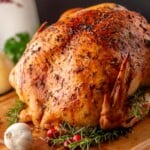
Oven Roasted Turkey
This oven roasted turkey is made with garlic herb butter, fresh rosemary, thyme, and a high-temperature start for golden-brown skin and juicy meat. No brining or basting required! Tested with a 20-pound whole turkey, this Thanksgiving recipe includes roasting temperatures, doneness guidance, and resting instructions.
Servings: 14 servings
Ingredients
Turkey and Herb Butter
- 1 20lb whole turkey fully thawed
- 1½ cups unsalted butter softened
- 6 cloves garlic finely minced
- 2 tablespoons fresh thyme finely chopped
- 2 tablespoons fresh rosemary finely chopped
- 1½ teaspoons paprika
- 2 teaspoons kosher salt for the herb butter
- 1 teaspoon ground black pepper for the herb butter
- Additional kosher salt and black pepper for seasoning the exterior and cavity
Aromatics
- 1 large yellow onion quartered
- 1 whole lemon halved
- 1 head garlic halved crosswise
- 3 sprigs fresh thyme
- 3 sprigs fresh rosemary
Instructions
- Preheat the oven to 500°F. Position the oven rack low enough to accommodate the turkey and roasting pan without touching the top of the oven. Allow the oven to fully preheat.
- Remove the neck and giblets from the fully thawed turkey, checking both cavities. Pat the turkey very dry inside and out with paper towels. Place it breast-side up on a roasting rack inside a large roasting pan.
- In a medium bowl, combine the softened butter, minced garlic, chopped thyme, rosemary, paprika, 2 teaspoons kosher salt, and 1 teaspoon black pepper. Mix until evenly combined.
- Gently loosen the skin over the turkey breasts with your fingers, being careful not to tear it. Loosen the skin around the thighs where accessible. Spread approximately two-thirds of the herb butter directly onto the meat underneath the skin, concentrating on the breasts.
- Spread the remaining herb butter over the breasts, legs, and wings. A spoon or small spatula works well if the butter sticks to your hands instead of the skin. Season the exterior and cavity with additional kosher salt and black pepper as needed, accounting for any salt already added by the manufacturer.
- Loosely place the quartered onion, lemon halves, halved garlic head, and fresh thyme and rosemary sprigs inside the cavity. Don't pack them tightly. Leave enough room for heat to circulate.
- Place the turkey in the preheated 500°F oven and roast uncovered for 30 minutes.
- Without removing the turkey, reduce the oven temperature to 350°F. Continue roasting until the turkey reaches the proper internal temperature. There's no need to baste.
- If the breast skin begins browning too quickly, loosely cover just the breast area with aluminum foil. During testing, I tented the breasts approximately 2 hours into roasting to prevent them from getting too dark.
- Continue roasting until the thickest part of the breast and the innermost thigh and wing reach at least 165°F. For more tender dark meat, the thighs can reach 170–175°F. Avoid touching bone with the thermometer. My 20-pound turkey took approximately 4 hours total, but always rely on internal temperature rather than cooking time.
- Remove it from the oven and loosely tent with aluminum foil. Let it rest for 30–60 minutes before carving.
- Transfer the turkey to a carving board, remove the aromatics, and carve. Reserve the pan drippings for homemade turkey gravy.
Video
Notes
- Turkey size: This recipe was tested with a 20-pound turkey. Smaller or larger birds will have different roasting times, and the herb butter quantity may need adjusting.
- Thawing: Make sure the turkey is completely thawed before roasting. A 20-pound turkey takes approximately 5 days to thaw in the refrigerator.
- Salt: Check the turkey packaging before seasoning. Self-basting or solution-injected turkeys may already contain added salt.
- Butter: If the softened herb butter won't stick to the outside of the turkey, use the back of a spoon or a small spatula to spread it.
- Roasting: Start at 500°F for 30 minutes, then reduce to 350°F. If the breast skin browns too quickly, tent just the breasts loosely with aluminum foil.
- Doneness: Check the thickest part of the breast and the innermost thigh and wing. All should reach at least 165°F. The thighs can reach 170–175°F for a more tender texture.
- Resting: Let the turkey rest for 30–60 minutes before carving. Save the pan drippings for homemade turkey gravy.
Nutrition
Serving: 6ounces | Calories: 186kcal | Carbohydrates: 3g | Protein: 1g | Fat: 20g | Saturated Fat: 13g | Polyunsaturated Fat: 1g | Monounsaturated Fat: 5g | Trans Fat: 1g | Cholesterol: 52mg | Sodium: 336mg | Potassium: 51mg | Fiber: 1g | Sugar: 1g | Vitamin A: 781IU | Vitamin C: 4mg | Calcium: 21mg | Iron: 0.4mg